Click Here For more details

What is a dinosaur? & when did they live??

What is a dinosaur? & when did they live??

Tuesday, 25 May 2010

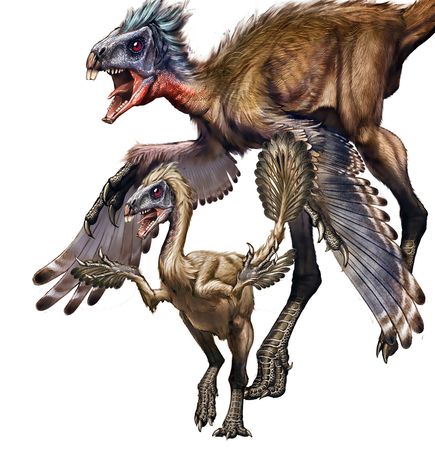
Similicaudipteryx.


Similicaudipteryx is known from three specimens ranging from young juvenile to adult. It was a small oviraptorosaur similar to the closely related Caudipteryx. Like Caudipteryx, it had a short snout with a downcurved lower jaw. It had relatively short arms and long legs. Similicaudipteryx also differed from its relatives by possessing a dagger-shaped pygostyle (the bone at the end of the tail to which feathers anchor in birds) and several unique features of the back vertebrae. The only other oviraptorosaur reported to have a pygostyle is Nomingia, though the feature is widespread in more advanced birds and appears to have evolved at least twice.[1]

Raptor


Velociraptor (pronounced /vɨˈlɒsɨræptər/; meaning 'swift seizer'[1]) is a genus of dromaeosaurid theropod dinosaur that existed approximately 75 to 71 million years ago during the later part of the Cretaceous Period.[2] Only two species are currently recognized, although others have been assigned in the past. The type species is V. mongoliensis; fossils of this species have been discovered in both Inner and Outer Mongolia in central Asia. A second species, V. osmolskae, was named in 2008 for skull material from Inner Mongolia.
Smaller than other dromaeosaurids like Deinonychus and Achillobator, the turkey-sized Velociraptor nevertheless shared many of the same anatomical features. It was a bipedal, feathered carnivore with a long, stiffened tail and an enlarged sickle-shaped claw on each hindfoot, which is thought to have been used to kill its prey. Velociraptor can be distinguished from other dromaeosaurids by its long and low skull, with an upturned snout.
Velociraptor (commonly shortened to 'raptor') is one of the dinosaur genera most familiar to the general public due to its prominent role in the Jurassic Park motion picture series. In the films it was shown with anatomical inaccuracies, including being much larger than it was in reality and without feathers. It is also well known to paleontologists, with over a dozen recovered fossil skeletons—the most of any dromaeosaurid. One particularly famous specimen preserves a Velociraptor locked in combat with a Protoceratops.

Stegosaurus


Stegosaurus was up to 26-30 feet long (8-9 m), about 9 feet tall (2.75 m), and weighed about 6,800 pounds (3100 kg). Its small brain was only the size of a walnut (weighing roughly 2.5 - 2.9 ounces (70 - 80 grams). Its skull was long. pointed, and narrow; it had a toothless beak and small cheek teeth. Its head was carried close to the ground, probably no more than 3 feet (1 m) high.


Stegosaurus (pronounced /ˌstɛɡɵˈsɔrəs/) is a genus of stegosaurid armored dinosaur from the Late Jurassic period (late Kimmeridgian to Early Tithonian) in what is now western North America. In 2006, a specimen of Stegosaurus was announced from Portugal, showing that they were present in Europe as well.[1] Due to its distinctive tail spikes and plates, Stegosaurus is one of the most recognizable dinosaurs, along with Tyrannosaurus, Triceratops, and Apatosaurus. The name Stegosaurus means "roof-lizard" and is derived from the Greek στέγος-, stegos- ("roof") and σαῦρος, -sauros ("lizard").[2] At least three species have been identified in the upper Morrison Formation and are known from the remains of about 80 individuals. They lived some 150 to 145 million years ago, in an environment and time dominated by the giant sauropods Diplodocus, Camarasaurus, and Apatosaurus.
A large, heavily built, herbivorous quadruped, Stegosaurus had a distinctive and unusual posture, with a heavily rounded back, short forelimbs, head held low to the ground and a stiffened tail held high in the air. Its array of plates and spikes has been the subject of much speculation. The spikes were most likely used for defense, while the plates have also been proposed as a defensive mechanism, as well as having display and thermoregulatory (heat control) functions. Stegosaurus was the largest of all the stegosaurians (bigger than genera such as Kentrosaurus and Huayangosaurus) and, although roughly bus-sized, it nonetheless shared many anatomical features (including the tail spines and plates) with the other stegosaurian genera.